

Research journal
Selank vs Semax — and the combined nasal blend
Selank and Semax often share the same forum thread, but they came from different parent sequences and are studied around different questions. We compare the two, then look at what your experiment gains—and loses—when both appear in one combined nasal format.
Two Russian peptide stories, not one nootropic
Selank is a synthetic analogue related to tuftsin, an immune-linked peptide fragment. Semax was developed from a short ACTH-related sequence without the full hormone’s endocrine activity. Their histories overlap geographically and both appear in nasal research, but their parent sequences and proposed targets are different.
Selank literature often discusses stress-related behaviour, immune signalling and neurotransmitter systems. Semax papers more often explore neuroprotection, learning, cerebral blood flow and neurotrophic signalling. Those themes overlap enough to invite comparison, not enough to make the molecules interchangeable.
Why forum comparisons outrun the evidence
Community posts tend to describe Selank as calming and Semax as focusing or stimulating. Those labels come largely from personal reports and small, region-specific research programmes. They are useful for identifying the questions readers ask, but they do not provide controlled head-to-head evidence or a reliable prediction for an individual result.
The nasal format adds another variable. Intranasal delivery is studied because it may change absorption and access compared with a dry vial, but formulation, device output and stability matter. Evidence for a molecule cannot be transferred wholesale to every spray carrying the same name.
What changes in the Selank + Semax Nasal 20 mg blend
The Peptomi Selank + Semax Nasal 20 mg product supplies both peptides in one combined nasal format. That makes it useful for a combination research question, but it is not a new peptide and the 20 mg label is the combined total rather than evidence that both components behave identically.
A blend also removes single-variable clarity. If an assay changes, the combined material alone cannot show whether Selank, Semax or an interaction produced the observation. Standalone products are better controls when attribution matters; the blend belongs in a design that explicitly asks about the pair.
Need concentration maths for a labelled vial mass? Use the peptide calculator.
Matching research vials
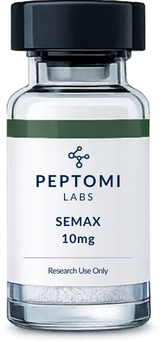
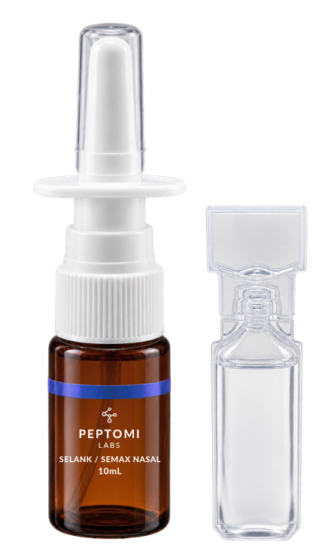
Peptomi Labs supplies research-grade materials for qualified laboratory use. These notes are not medical advice and they are not a protocol for human or veterinary use. Not for human or veterinary consumption.