

Research journal
Bacteriostatic Water vs Sterile Saline
Both liquids can look like clear sterile water in a vial, but their labels describe different materials. Bacteriostatic water contains a preservative; sterile saline contains sodium chloride. The right comparison starts there, not with whichever bottle is closest.
Clear liquids with different recipes
Bacteriostatic water is sterile water containing a preservative, commonly 0.9% benzyl alcohol. Sterile normal saline is water containing 0.9% sodium chloride and, unless its label says otherwise, no bacteriostatic preservative. One changes preservative exposure; the other changes ionic strength and tonicity.
The matching “0.9%” numbers describe different ingredients and should never be treated as equivalent. A clear appearance cannot confirm composition. Read the full label, concentration, container type and expiry information before the liquid enters any laboratory workflow.
Multi-dose language is about the container and preservative
Bacteriostatic water is commonly packaged for repeated withdrawals because the preservative inhibits microbial growth after entry. It does not make poor aseptic technique safe and it does not remain sterile indefinitely. Plain sterile saline is often supplied as single-use material because it lacks that preservative barrier.
Packaging matters as much as the generic name. A saline product can be preserved or unpreserved, and a small ampoule is handled differently from a multi-dose vial. Follow the actual manufacturer label rather than a rule copied from a forum or another bottle.
Compatibility decides the laboratory choice
Some methods specify a particular diluent because salt, pH, preservative or osmolarity can affect solubility, stability, cells or assay readouts. Substituting bacteriostatic water for saline—or the reverse—changes the experimental material even when the final volume is unchanged.
The safe research approach is simple: use the diluent named by the validated method or product documentation, record its full composition and keep aseptic controls in place. This comparison explains labels; it is not a universal reconstitution instruction.
Need concentration maths for a labelled vial mass? Use the peptide calculator.
Matching research vials
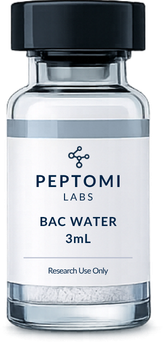
Peptomi Labs supplies research-grade materials for qualified laboratory use. These notes are not medical advice and they are not a protocol for human or veterinary use. Not for human or veterinary consumption.