

Research journal
MOTS-c vs SS-31
Calling MOTS-c and SS-31 “mitochondrial peptides” is accurate but incomplete. One is encoded inside mitochondrial DNA and studied as a signal; the other was designed to concentrate at the inner mitochondrial membrane. That difference changes the whole experiment.
Both point to mitochondria from opposite directions
MOTS-c is a short peptide encoded within mitochondrial DNA and studied as a signal that can communicate metabolic stress beyond the organelle. SS-31, also known in research as elamipretide, is a synthetic aromatic-cationic tetrapeptide designed to concentrate at the inner mitochondrial membrane.
One begins as a mitochondrially encoded message; the other is an outside molecule selected for a mitochondrial destination. The shared “mitochondrial peptide” label is therefore a location-level similarity, not a claim that the two use the same pathway.
Metabolic signalling versus membrane research
MOTS-c experiments examine glucose handling, exercise responses, cellular stress programmes and movement between mitochondria and nucleus. SS-31 experiments focus more directly on cardiolipin, membrane organisation, electron-transport efficiency and oxidative stress. The endpoints can overlap while the proposed starting mechanisms remain different.
Online “energy peptide” descriptions flatten those distinctions into a promised feeling. A change in a mouse exercise test, a cultured cell or a mitochondrial assay is not proof of subjective energy in people. The model and endpoint need to stay attached to every claim.
The evidence has different shapes
MOTS-c evidence is still led by cell and animal work, with growing interest in age-related and metabolic signalling. SS-31 has progressed into human clinical studies and now has a narrow accelerated approval for Barth syndrome, but a negative primary mitochondrial-myopathy trial and mixed results elsewhere do not support a universal “energy” or anti-ageing effect.
For a research design, choose the molecule that matches the question. MOTS-c fits signalling and mitochondrial-genome communication; SS-31 fits membrane-targeted work. Testing both is a comparison, not a reason to replace one with the other or assume combined benefit.
Need concentration maths for a labelled vial mass? Use the peptide calculator.
Matching research vials
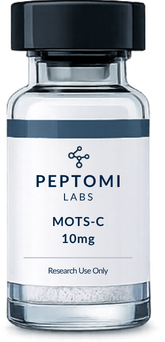
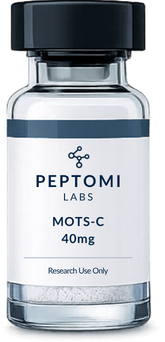

Peptomi Labs supplies research-grade materials for qualified laboratory use. These notes are not medical advice and they are not a protocol for human or veterinary use. Not for human or veterinary consumption.